
Long distance moving
Long distance movers in California
California is where our trucks are based, Culver City, so it is the one state on this site where the crew loading you and the crew unloading you have very likely met. Eight metros, our own trucks, and a binding price after survey.
- One carrier door to door
- 7–12 days east coast lanes
- 30 days storage included
- USDOT 2138595 · MC-744411 checkable on FMCSA SAFER

- East coast lanes
- 7–12 days driving days once loaded
- Midwest lanes
- 4–8 days typical spread
- Storage in transit
- 30 days included
- Authority
- USDOT 2138595 licensed carrier
The same window applies in both directions: a lane is as long one way as the other. Transit is driving days from the load date, not calendar days from booking, and both ends of the spread go on your bill of lading.
What changes here
What a move in or out of California involves
We are movers, not a relocation guide, so this is the version from the truck: what actually decides a California move, whichever way you are going.

20 days to register a vehicle after you arrive
The clock starts the day you arrive
California gives a new resident twenty days to register an out-of-state vehicle. It is the tightest deadline of any state we serve and it catches people who assumed they had a month or two, particularly anyone shipping a car separately from the household goods: the car has to be here before the clock can be satisfied. If we are moving the vehicle as well as the house, the delivery window on the auto transport is the number that matters, and a coordinator will line the two up rather than leaving you to.

California is not one move
Eight metros in one state, and they are eight different job markets: entertainment and port logistics in Los Angeles, tech in the Bay Area, defence and biotech in San Diego, state government in Sacramento. For a mover the consequence is practical rather than economic: the destination metro decides the vehicle. Sacramento, Concord and the Central Valley are usually a straight 53-foot delivery; San Francisco, the Los Angeles hill streets and coastal San Diego are shuttle country, and that is costed at survey rather than discovered on the day.

Two passes, and both are inside California
The winter constraint here is in the state rather than on the way to it. Northbound out of Los Angeles I-5 crosses the Tejon Pass, the Grapevine, which Caltrans closes outright for snow and ice. Eastbound out of Sacramento, I-80 climbs Donner, where chain controls are routine from November to March. Neither adds a mile and both add hours, which is why a January window into or out of California is wider than the same move in July. A loaded 53-foot trailer waits a closure out; we build that into the spread rather than promise around it.

8 metros we crew regularly
We are in the state every month
We run into Los Angeles, San Francisco, San Diego, San Jose, Anaheim, Concord, Temecula and Visalia on a repeating basis, not on demand. That is what makes a delivery spread a spread of days rather than of weeks, and it is why we can tell you at survey which vehicle can physically reach your door.
Figures shown are ours: metros we crew, and the transit spreads our dispatch works to. Where we have no sourced number for a claim, we have not printed one.
What it costs
What it costs to move out of California
Weight and distance set the price before anything else. On the market data below, a two-to-three-bedroom household runs $4,920 – $9,220 to New York and $3,810 – $8,320 to Illinois. Ours is one number, in writing, after a survey.
| Home size | Typical weight | To New York | To Illinois |
|---|---|---|---|
| Studio or 1 bed one bedroom of contents | 2,000 – 3,500 lb | $1,540 – $6,680 | $1,400 – $5,530 |
| 2 – 3 bedrooms the most common interstate move | 4,000 – 9,000 lb | $4,920 – $9,220 | $3,810 – $8,320 |
| 4+ bedrooms often needs a trailer to itself | 10,000 – 14,000 lb | $8,990 – $14,280 | $6,930 – $12,160 |
The dollar ranges are the MARKET rate for these lanes, not our quote: California to New York and California to Illinois. moveBuddha's monthly dataset of live quotes across vetted movers, last updated 31 August 2026, full-service movers column. Weights are the industry rule of thumb. We price your move from a survey of your actual inventory and give you one binding number.
Get a binding priceIncluded and extra
What your final price includes
The complaint in this industry is always the bill that grew. This is the line between included and extra, before you have to ask.
- Included One truck, one crew The crew that loads you is the crew that unloads you.
- Included Storage for 30 days Useful when a closing slips.
- Included Basic cover 60 cents for every pound an item weighs.
- Extra Full cover Pays to repair or replace what we list together.
- Extra Packing and crates Up to 15 boxes is partial, more than that is full.
- Extra Car shipping Open or enclosed.
Long distance moving routes from California
Road distance and the transit window we plan against on the lanes we run most out of California.





Where we crew
The California cities we crew
We move anywhere in California. These are the places we run often enough to know the access before we arrive; each one opens a page on what a move out of it involves.
-
 Anaheim
 keeps large trucks out of residential streets except while loading, so there is…
Anaheim
Anaheim keeps large trucks out of residential streets except while loading, so there is…
-
 Concord
 is the East Bay one, in Contra Costa County — production’s page never…
Concord
Concord is the East Bay one, in Contra Costa County — production’s page never…
-
 Los Angeles
Our own crews and our own trucks, out of a Culver City base. We…
Los Angeles
Our own crews and our own trucks, out of a Culver City base. We…
-
 San Diego
 does not sell a moving permit, and the private no-parking signs that…
San Diego
San Diego does not sell a moving permit, and the private no-parking signs that…
-
 San Francisco
The distance is the easy part here. We pull the SFMTA no-parking permit at…
San Francisco
The distance is the easy part here. We pull the SFMTA no-parking permit at…
-
 San Jose
 issues a Tow-Away Permit, which means the space you reserve is actually…
San Jose
San Jose issues a Tow-Away Permit, which means the space you reserve is actually…
-
 Temecula
 is gates and heat. Most addresses sit behind an association barrier, and inland…
Temecula
Temecula is gates and heat. Most addresses sit behind an association barrier, and inland…
-
 Visalia
 is Central Valley — far enough from both coasts that Los Angeles and…
Visalia
Visalia is Central Valley — far enough from both coasts that Los Angeles and…
On the day
What arrives at your door in California
This is the state where a full-size trailer least often reaches the door. San Francisco hill streets, older Los Angeles blocks and anywhere with a street permit regime usually mean a shuttle, established at survey, not on the morning.

- 53 ft
- trailer, the long haul standard
- 26 ft
- shuttle where a trailer cannot go
- 7–12 days
- east coast lanes
- 30 days
- storage in transit, included
Delivery and unload. The same company that loaded you in your old state unloads you in California: no handover to a carrier you did not choose.
How a long distance move runsAfter the truck is loaded
The part most movers do not put in writing. These are your rights and our obligations on an interstate move in or out of California, in the order they happen.
-
You get a spread, not a date
Your bill of lading carries a delivery window, 7–12 days in driving days on East coast lanes. A single promised date on an interstate move is a date somebody intends to miss.
-
The driver calls ahead
You get 24 hours of notice before delivery so somebody can be at the property. If the new place is not ready, the shipment goes into storage in transit rather than onto your driveway.
-
Check it before you sign
Walk the inventory against the sheet at delivery and note anything damaged on the paperwork before signing. That note is what makes a later claim straightforward instead of contested.
-
You have nine months to claim
Federal rules give you nine months from delivery to file a written claim on an interstate move. We acknowledge within 30 days and settle, deny or make an offer within 120.
Where to go next
Every California move is one or more of these, and these are the two lanes we run most out of the state. Storage is included for thirty days whether you plan to use it or not.
-
 Long distance moving
the whole move, door to door, one carrier
Long distance moving
the whole move, door to door, one carrier
-
 Packing and crating
materials included, crates for the awkward things
Packing and crating
materials included, crates for the awkward things
-
 Storage
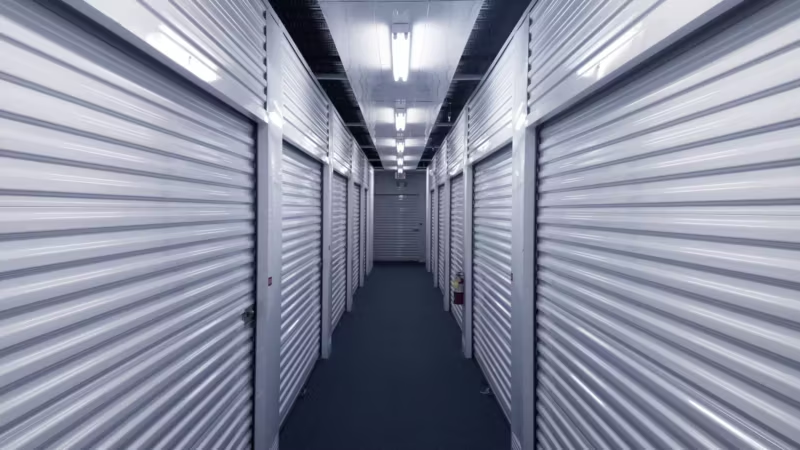
30 days included, in a facility we control
Storage
30 days included, in a facility we control
-
 Auto transport
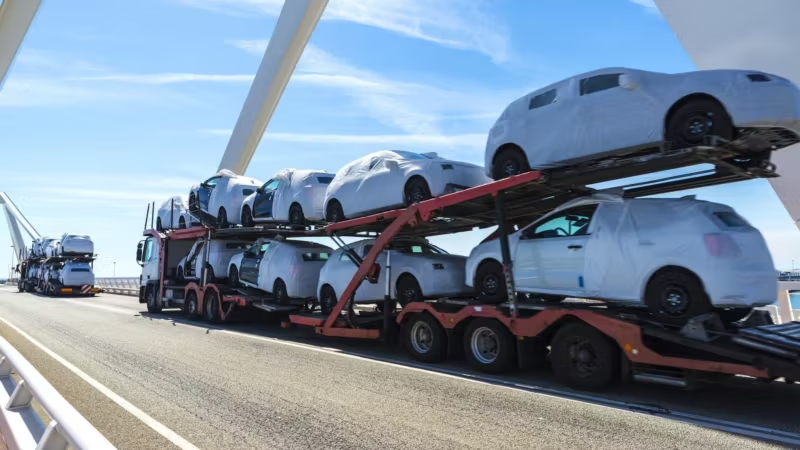
open or enclosed, door to door or terminal
Auto transport
open or enclosed, door to door or terminal
-
 Movers across New York
a lane we run from California
Movers across New York
a lane we run from California
-
 Movers across Illinois
a lane we run from California
Movers across Illinois
a lane we run from California
-
 Moving from California to Texas
the eastbound lane page
Moving from California to Texas
the eastbound lane page
-
 Moving from California to Florida
the I-10 lane page
Moving from California to Florida
the I-10 lane page
-
 Moving from Texas to California
the lane in the other direction
Moving from Texas to California
the lane in the other direction
Reviews from customers on our long-distance lanes
“He demonstrated exceptional problem-solving skills, especially when faced with getting some pieces out of a tight spot.”
-
Tatiana H.
Read on YelpI contacted Cross Country in a panic when another moving company completely blew their pick up date and left me stranded. Not only was Cross Country able to pick up my life within 72 hours, every single person I interacted with was kind, thorough and (gasp!) even funny! Read the full review Read less
I contacted Cross Country in a panic when another moving company completely blew their pick up date and left me stranded. Not only was Cross Country able to pick up my life within 72 hours, every single person I interacted with was kind, thorough and (gasp!) even funny! Moving is tough. This move was from Boulder, CO to Detroit, MI in the middle of winter. The team at Cross Country not only saved the day, they went above and beyond to make sure all our timing hit just right. My stuff was picked up on a Tuesday and delivered on Friday of the same week. The movers in Colorado were great – easy going yet efficient and very careful with my items. The dispatch team is as good as it gets. Overall, dependable, quality service at competitive rates. They may be slightly more than others but when it comes to moving, you get what you pay for. These guys offer peace of mind and ease in addition to outstanding service. Would absolutely use again.
-
Alyssa H.
Read on Googlerelocating two storage facilities into one is a massive endeavor. i feel fortunate to have been directed to the team at cross country movers group. like any sensible person, i gathered 3 estimates for shifting my packing machinery. Read the full review Read less
relocating two storage facilities into one is a massive endeavor. i feel fortunate to have been directed to the team at cross country movers group. like any sensible person, i gathered 3 estimates for shifting my packing machinery. the three proposals were highly competitive, but the technician from cross country movers group elevated the estimation process. he inquired about all the right details and delivered a comforting customer experience. from inception to completion, this team took charge of everything. i was kept in the loop all week with updates on their progress or any possible delays. collaborating with the crew was the most seamless relocating experience i’ve ever had. i was able to concentrate on other tasks while they handled the move. the work was finished in 3 weeks, with 4 large presses, 2 small presses, and 5 other machines all relocated without a single issue. i greatly appreciate the outstanding service you guys provided!
-
Wendi W.
Read on YelpMy husband and I recently made a cross country move from SF Bay area to Maryland. We used Cross Country movers and had an excellent experience. Read the full review Read less
My husband and I recently made a cross country move from SF Bay area to Maryland. We used Cross Country movers and had an excellent experience. Researching online about long-distance moves resulted in many very negative and costly experiences, so we were naturally concerned about selecting a moving company. None of those concerns applied to our experience with CCM and we highly recommend their services. From the walk-thru with us for the estimate, to preparation, packing and pick-up, their entire team was a pleasure to work with. On moving day, the team was very professional and responsive. I had packed the majority of our household goods, but left the larger and more fragile items, along with the furniture, to be packed by CCM. They were extremely careful with our household goods in disassembly, packing and loading. They were very efficient and completed the load up in the time frame promised (1.5 days). They made sure to address any concerns we had with the move process and the security of our furniture and goods before they left.
Moving in and out of California: the practical part
We run into and out of California every month, most often Los Angeles, San Francisco, San Diego, San Jose, Anaheim, Concord, Temecula and Visalia. We run into Arizona, Colorado, New Mexico, Oregon and Washington on the same crews. The move itself is the predictable part: a survey fixes the inventory and the weight, the weight and the mileage fix the price, and the price goes on the paperwork before anything is loaded.
Access is the whole game here
More of our California surveys turn up an access problem than in any other state, and the pattern is consistent. San Francisco hill streets take a shuttle rather than a trailer on most addresses. Los Angeles wants a street parking permit in much of the city and the permit, not the truck, is the thing with a lead time. Concord and the East Bay are usually straightforward. Visalia and the Central Valley are the easiest access in the state. None of that changes what your move costs if it is established at survey; all of it changes the cost if it is discovered on the morning.
Every eastbound lane out of California is a week or more
San Francisco to New York is 2,902 miles, Los Angeles 2,790, San Diego 2,759. Whichever metro you leave from, the east coast is a seven-to-twelve-day window once loaded, and Chicago is only modestly closer at around 2,000. The price bands above track that geography. After mileage and weight come the access questions, settled at survey and written as line items, not met for the first time on moving day.
Booking a move out of California
Four to six weeks ahead for a summer date holds here as everywhere. One thing works in your favor, though: the fleet lives at Culver City, so the truck does not have to reach the state before it can load in it. If a closing slips or a lease shifts under you, say so early. An origin near our own yard is the easiest kind of date to move.
What we need from you on the first call
Two ZIP codes, a date you are working towards, and roughly how many rooms. That is enough for a coordinator to tell you which lane you are on, what the realistic spread is, and whether anything about either address is going to need a shuttle or a permit. Everything after that is the survey.
How long does a move to or from California take?
San Francisco to New York is 2,902 mi and runs 7–12 days once loaded; Los Angeles to New York is 2,790 mi and 7–12 days, the same numbers as the route table on this page. A lane is as long one way as the other, so those windows hold in both directions. You get the spread in writing on the bill of lading rather than a single date we might miss.
Can a 53-foot trailer reach my street in San Francisco or LA?
On many addresses, no, and that is a normal answer here rather than a bad one. A shuttle is a 26-foot truck that runs between your door and the trailer parked legally nearby. It is priced at survey with the reason written next to it, so it appears on the estimate rather than on the invoice. Give us the destination address and a coordinator will tell you which vehicle physically reaches it before you book.
Do you serve the whole of California?
We deliver anywhere in California. Los Angeles, San Francisco, San Diego, San Jose, Anaheim, Concord, Temecula and Visalia are the metros we crew regularly: the places we know the access before we arrive. Everywhere else starts with the destination ZIP: a coordinator confirms shuttle, permit and access questions before the price is set.
What does a move out of California cost?
Weight and mileage set the base, then access. On the market data above, a studio or one-bed to New York runs $1,540 – $6,680, and a four-plus-bedroom house to Illinois runs $6,930 – $12,160. Those are third-party rates to sanity-check any estimate against, including ours. A binding price needs a survey, and anybody quoting a firm number off a phone call is guessing.
Can you store my shipment until my place is ready?
Thirty days of storage in transit is included on long distance moves, in a facility we control, going out on a date you set.
Are you a carrier or a broker?
A carrier. We hold our own operating authority, USDOT 2138595 and MC-744411, and our own crews and trucks run the move end to end. You can check both in the FMCSA SAFER database without asking us.
Moving to or from California?
Two ZIP codes and a date. A coordinator will call you back with the lane, the spread and what the survey needs to look at.
Get a price for your move from California
Two ZIP codes and a date is enough to start. A coordinator confirms the lane, the access at both ends and what the survey needs to look at before anything is booked.