
Long distance moving
Long distance movers in Colorado
Every truck we run into Denver crosses the I-70 mountain corridor, and from 1 September to 31 May that corridor has a traction law on it. We plan the delivery window around the pass rather than promising past it.
- One carrier door to door
- 7–12 days east coast lanes
- 30 days storage included
- USDOT 2138595 · MC-744411 checkable on FMCSA SAFER

- East coast lanes
- 7–12 days driving days once loaded
- Midwest lanes
- 4–8 days typical spread
- Storage in transit
- 30 days included
- Authority
- USDOT 2138595 licensed carrier
The same window applies in both directions: a lane is as long one way as the other. Transit is driving days from the load date, not calendar days from booking, and both ends of the spread go on your bill of lading.
What changes here
What a move in or out of Colorado involves
We are movers, not a relocation guide, so this is the version from the truck: what actually decides a Colorado move, whichever way you are going.
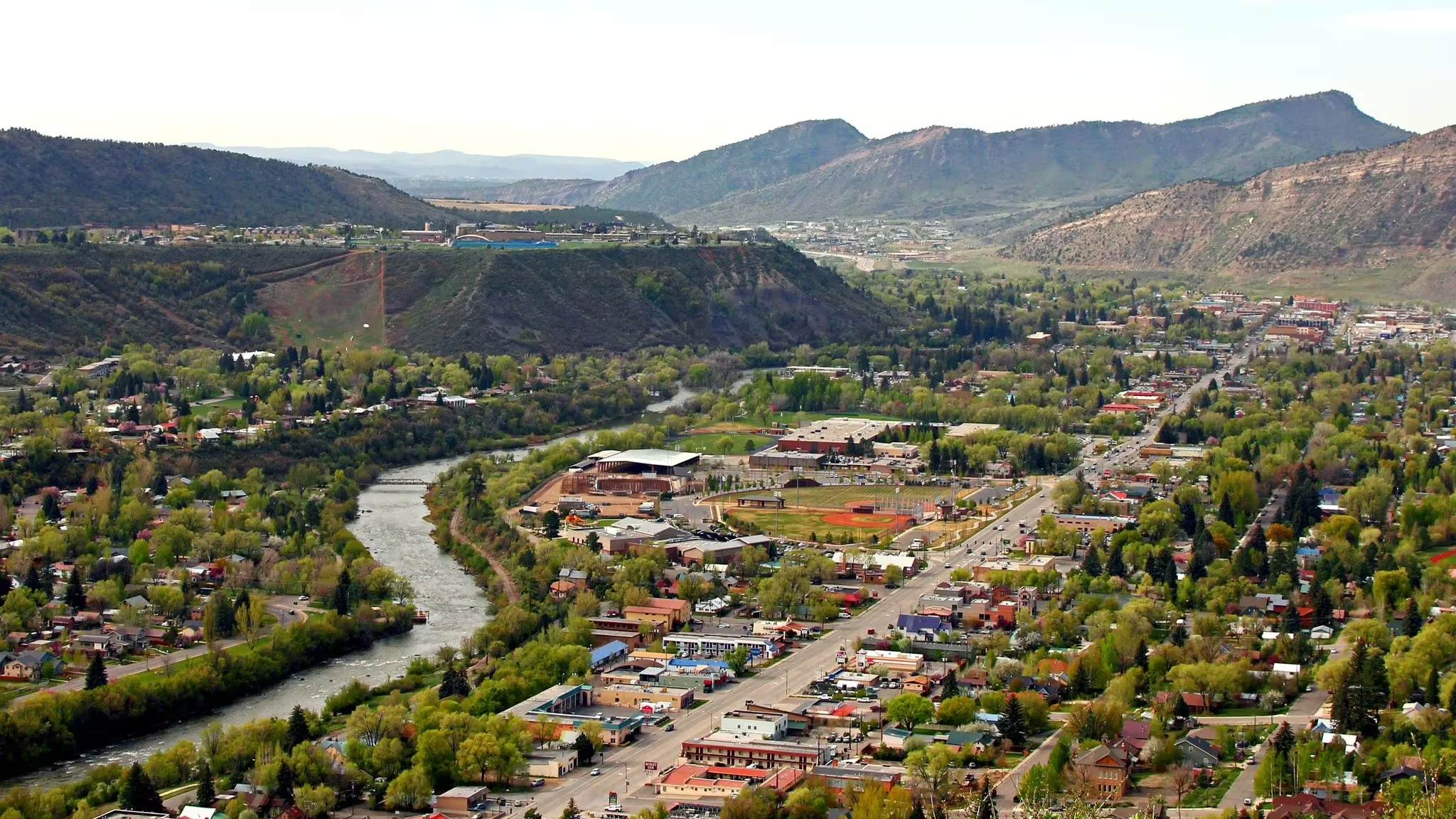
1 Sep – 31 May Colorado traction law, I-70 corridor
The pass, not the mileage, sets the window
Colorado runs a traction law on the I-70 mountain corridor between Dotsero and Morrison from 1 September to 31 May, and a separate rule requiring trucks to carry chains on I-70 between mile 163 and mile 259 over the same dates. There are also left-lane restrictions for commercial vehicles at the Eisenhower and Johnson tunnels, on the west side of Vail Pass, through Glenwood Canyon, at Dowd Junction and on Georgetown Hill. None of that is unusual for a carrier that runs the lane every month. All of it is why a Denver delivery window is a spread of days: a 53-foot trailer waits a closure out rather than driving into it.

Federal campuses, and a gate to get through
Front Range employment leans hard on aerospace and the federal government: Buckley Space Force Base in Aurora, the Denver Federal Center in Lakewood, Lockheed Martin's space business south of Littleton, and the supplier corridor along US 36 towards Boulder. If your new address sits on a base or a secured campus, the delivery is not just a date: the crew needs gate credentials arranged in advance and the truck may have to be listed. Tell us at survey and we handle it; found out on the morning it costs you the slot.

1 metro we crew regularly
We are in the state every month
We run into Denver on a repeating basis, not on demand. That is what makes a delivery spread a spread of days rather than of weeks, and it is why we can tell you at survey which vehicle can physically reach your door.
Figures shown are ours: metros we crew, and the transit spreads our dispatch works to. Where we have no sourced number for a claim, we have not printed one.
What it costs
What it costs to move out of Colorado
Weight and distance set the price before anything else. On the market data below, a two-to-three-bedroom household runs $2,890 – $7,210 to California and $2,550 – $6,000 to Arizona. Ours is one number, in writing, after a survey.
| Home size | Typical weight | To California | To Arizona |
|---|---|---|---|
| Studio or 1 bed one bedroom of contents | 2,000 – 3,500 lb | $1,310 – $5,370 | $1,310 – $4,050 |
| 2 – 3 bedrooms the most common interstate move | 4,000 – 9,000 lb | $2,890 – $7,210 | $2,550 – $6,000 |
| 4+ bedrooms often needs a trailer to itself | 10,000 – 14,000 lb | $5,130 – $9,220 | $4,320 – $9,100 |
The dollar ranges are the MARKET rate for these lanes, not our quote: Colorado to California and Colorado to Arizona. moveBuddha's monthly dataset of live quotes across vetted movers, last updated 31 August 2026, full-service movers column. Weights are the industry rule of thumb. We price your move from a survey of your actual inventory and give you one binding number.
Get a binding priceIncluded and extra
What your final price includes
The complaint in this industry is always the bill that grew. This is the line between included and extra, before you have to ask.
- Included One truck, one crew The crew that loads you is the crew that unloads you.
- Included Storage for 30 days Useful when a closing slips.
- Included Basic cover 60 cents for every pound an item weighs.
- Extra Full cover Pays to repair or replace what we list together.
- Extra Packing and crates Up to 15 boxes is partial, more than that is full.
- Extra Car shipping Open or enclosed.
Long distance moving routes from Colorado
Road distance and the transit window we plan against on the lanes we run most out of Colorado.



Where we crew
The Colorado cities we crew
We move anywhere in Colorado. These are the places we run often enough to know the access before we arrive; each one opens a page on what a move out of it involves.
-
 Denver
In Colorado a mover’s permit number starts with HHG. A freight permit is the…
Denver
In Colorado a mover’s permit number starts with HHG. A freight permit is the…
On the day
What arrives at your door in Colorado
Getting into Denver is the seasonal question; getting to your door is the ordinary one. Foothill and mountain addresses west of the metro are where a 53-foot trailer most often cannot go, and the answer is a shuttle from the nearest place it can legally stop.

- 53 ft
- trailer, the long haul standard
- 26 ft
- shuttle where a trailer cannot go
- 7–12 days
- east coast lanes
- 30 days
- storage in transit, included
Delivery and unload. The same company that loaded you in your old state unloads you in Colorado: no handover to a carrier you did not choose.
How a long distance move runsAfter the truck is loaded
The part most movers do not put in writing. These are your rights and our obligations on an interstate move in or out of Colorado, in the order they happen.
-
You get a spread, not a date
Your bill of lading carries a delivery window, 7–12 days in driving days on East coast lanes. A single promised date on an interstate move is a date somebody intends to miss.
-
The driver calls ahead
You get 24 hours of notice before delivery so somebody can be at the property. If the new place is not ready, the shipment goes into storage in transit rather than onto your driveway.
-
Check it before you sign
Walk the inventory against the sheet at delivery and note anything damaged on the paperwork before signing. That note is what makes a later claim straightforward instead of contested.
-
You have nine months to claim
Federal rules give you nine months from delivery to file a written claim on an interstate move. We acknowledge within 30 days and settle, deny or make an offer within 120.
Where to go next
Every Colorado move is one or more of these, and these are the two lanes we run most out of the state. Storage is included for thirty days whether you plan to use it or not.
-
 Long distance moving
the whole move, door to door, one carrier
Long distance moving
the whole move, door to door, one carrier
-
 Packing and crating
materials included, crates for the awkward things
Packing and crating
materials included, crates for the awkward things
-
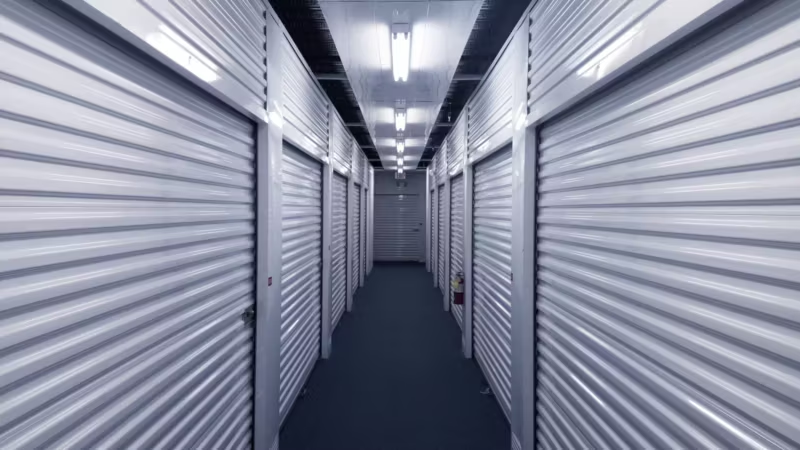 Storage
30 days included, in a facility we control
Storage
30 days included, in a facility we control
-
 Auto transport
open or enclosed, door to door or terminal
Auto transport
open or enclosed, door to door or terminal
-
 Movers across California
a lane we run from Colorado
Movers across California
a lane we run from Colorado
-
 Movers across Arizona
a lane we run from Colorado
Movers across Arizona
a lane we run from Colorado
Reviews from customers on our long-distance lanes
“The movers in Colorado were great – easy going yet efficient and very careful with my items.”
-
Derrick V.
Read on GoogleThanks to these guys, my move was easy and fast. They were recommended by a friend and he insisted I hire them. And I am glad I listened to her. After booking this team for my move, I was still a bit worried. But they clearly changed all that on the moving day. Read the full review Read less
Thanks to these guys, my move was easy and fast. They were recommended by a friend and he insisted I hire them. And I am glad I listened to her. After booking this team for my move, I was still a bit worried. But they clearly changed all that on the moving day. The foreman and his 3 helpers came on time and were very active. They did not sit around and do nothing, they worked the entire time. As a result of their hard work, all my things were intact. Thank you very much.
-
Deirdre Maier
I used his moving company to relocate my entire office to a different location. Those guys are great. They packed everything carefully, nothing got damage, they are very professional and friendly. I highly recommend them.
Yelp -
Janie F.
They relocated my stuff with ease and no scratches. I had a great team to help me: hard working, courteous and punctual. Thanks to this cross country mover I moved with no stress.
Read on Google
Moving in and out of Colorado: the practical part
We run into and out of Colorado every month, most often Denver. We run into Arizona, California, New Mexico, Oregon and Washington on the same crews. The move itself is the predictable part: a survey fixes the inventory and the weight, the weight and the mileage fix the price, and the price goes on the paperwork before anything is loaded.
Winter deliveries into Denver
Between roughly November and March the honest planning assumption is that a pass closure adds hours, occasionally a day, and that it is unpredictable more than it is likely. What we will not do is quote a single delivery date into Denver in February and then explain the pass to you afterwards. If your move has a hard date at the far end (a lease start, a closing, an employer start date), say so on the first call and the load date gets set backwards from it with the pass built in.
Denver’s hauls are half a coast-to-coast
Los Angeles is 1,015 miles from Denver, San Francisco 1,250 and Phoenix 864. That is roughly half of what a coastal departure covers to reach the opposite coast, and the bands above are what the shorter haul buys. What Colorado adds back is priced in time rather than dollars: the corridor can widen a winter window, but it does not add a line to the invoice.
June to August is the quiet season on the I-70 corridor
The traction law is off the books for exactly three months, June through August, and a move that can choose its season gets its narrowest Denver window in them. The rest of the year is not worse, only written with more room.
What we need from you on the first call
Two ZIP codes, a date you are working towards, and roughly how many rooms. That is enough for a coordinator to tell you which lane you are on, what the realistic spread is, and whether anything about either address is going to need a shuttle or a permit. Everything after that is the survey.
How long does a move to or from Colorado take?
Denver to San Francisco is 1,250 mi and runs 4–7 days once loaded; Denver to Los Angeles is 1,015 mi and 3–6 days, the same numbers as the route table on this page. A lane is as long one way as the other, so those windows hold in both directions. You get the spread in writing on the bill of lading rather than a single date we might miss.
What happens if a mountain pass closes while my shipment is in transit?
The truck waits, and you are told. Chain laws and closures on the I-70 corridor are the winter risk on this lane and they are the reason your paperwork carries a delivery spread instead of a single date. A closure inside your spread is not a delay. It is what the spread is for. If it looks like running past the spread, the driver or a coordinator calls you before the window ends rather than after it.
Do you serve the whole of Colorado?
We deliver anywhere in Colorado. Denver is the metro we crew regularly: the places we know the access before we arrive. Everywhere else starts with the destination ZIP: a coordinator confirms shuttle, permit and access questions before the price is set.
What does a move out of Colorado cost?
Weight and mileage set the base, then access. On the market data above, a studio or one-bed to California runs $1,310 – $5,370, and a four-plus-bedroom house to Arizona runs $4,320 – $9,100. Those are third-party rates to sanity-check any estimate against, including ours. A binding price needs a survey, and anybody quoting a firm number off a phone call is guessing.
Can you store my shipment until my place is ready?
Thirty days of storage in transit is included on long distance moves, in a facility we control, going out on a date you set.
Are you a carrier or a broker?
A carrier. We hold our own operating authority, USDOT 2138595 and MC-744411, and our own crews and trucks run the move end to end. You can check both in the FMCSA SAFER database without asking us.
Moving to or from Colorado?
Two ZIP codes and a date. A coordinator will call you back with the lane, the spread and what the survey needs to look at.
Get a price for your move from Colorado
Two ZIP codes and a date is enough to start. A coordinator confirms the lane, the access at both ends and what the survey needs to look at before anything is booked.