
Long distance moving
Long distance movers in Washington
Washington levies no state income tax on wages, which is why a good share of our Seattle volume is people taking the same salary north. Steep streets and permits are the moving-day problem, and both are settled at survey.
- One carrier door to door
- 7–12 days east coast lanes
- 30 days storage included
- USDOT 2138595 · MC-744411 checkable on FMCSA SAFER

- East coast lanes
- 7–12 days driving days once loaded
- Midwest lanes
- 4–8 days typical spread
- Storage in transit
- 30 days included
- Authority
- USDOT 2138595 licensed carrier
The same window applies in both directions: a lane is as long one way as the other. Transit is driving days from the load date, not calendar days from booking, and both ends of the spread go on your bill of lading.
What changes here
What a move in or out of Washington involves
We are movers, not a relocation guide, so this is the version from the truck: what actually decides a Washington move, whichever way you are going.

1 Nov – 1 Apr chains carried over Snoqualmie Pass
No income tax, and one pass to plan around
Two facts do most of the work on this page. Washington taxes no wage income, which you can verify in an afternoon and which is the reason a large share of the moves we run into Seattle are lateral career moves rather than job changes. And trucks over 10,000 lb must carry chains from 1 November to 1 April over the state passes, Snoqualmie on I-90 among them, so a winter delivery from the midwest or east carries a wider spread than the same move in August.

Two counties, two completely different deliveries
Seattle's employment core is downtown and South Lake Union, but the volume we move follows the Eastside, Bellevue, Redmond and Kirkland, because that is where the housing which comes with those jobs is. The split decides the vehicle rather than the price: an Eastside address is usually a straight 53-foot delivery with somewhere legal to park, while Capitol Hill, Queen Anne and Ballard are narrow, steep, or both, and we plan a shuttle instead of discovering the need at the curb.
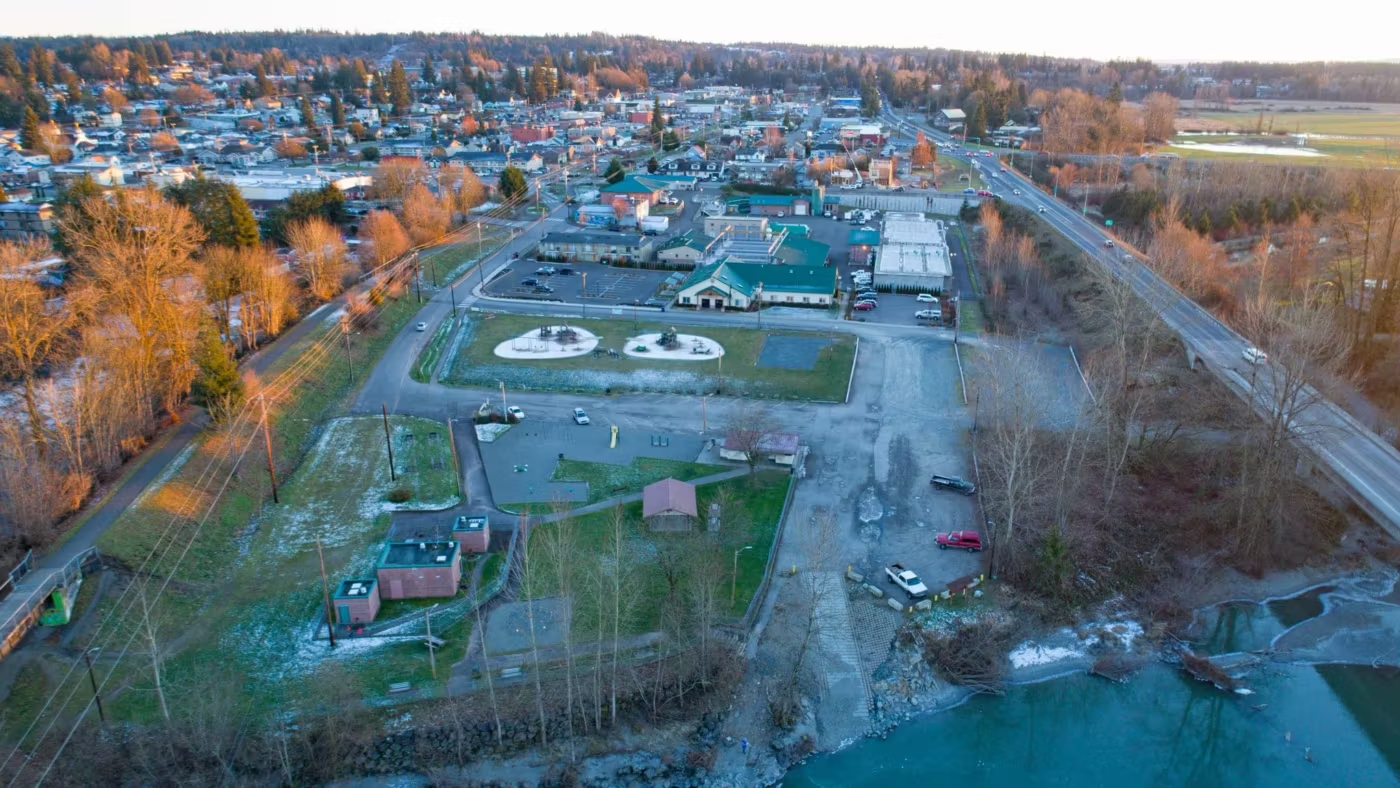
1 metro we crew regularly
We are in the state every month
We run into Seattle on a repeating basis, not on demand. That is what makes a delivery spread a spread of days rather than of weeks, and it is why we can tell you at survey which vehicle can physically reach your door.
Figures shown are ours: metros we crew, and the transit spreads our dispatch works to. Where we have no sourced number for a claim, we have not printed one.
What it costs
What it costs to move out of Washington
Weight and distance set the price before anything else. On the market data below, a two-to-three-bedroom household runs $3,250 – $8,010 to California and $3,620 – $8,450 to Arizona. Ours is one number, in writing, after a survey.
| Home size | Typical weight | To California | To Arizona |
|---|---|---|---|
| Studio or 1 bed one bedroom of contents | 2,000 – 3,500 lb | $1,500 – $6,080 | $1,500 – $6,280 |
| 2 – 3 bedrooms the most common interstate move | 4,000 – 9,000 lb | $3,250 – $8,010 | $3,620 – $8,450 |
| 4+ bedrooms often needs a trailer to itself | 10,000 – 14,000 lb | $5,270 – $10,010 | $6,290 – $11,680 |
The dollar ranges are the MARKET rate for these lanes, not our quote: Washington to California and Washington to Arizona. moveBuddha's monthly dataset of live quotes across vetted movers, last updated 31 August 2026, full-service movers column. Weights are the industry rule of thumb. We price your move from a survey of your actual inventory and give you one binding number.
Get a binding priceIncluded and extra
What your final price includes
The complaint in this industry is always the bill that grew. This is the line between included and extra, before you have to ask.
- Included One truck, one crew The crew that loads you is the crew that unloads you.
- Included Storage for 30 days Useful when a closing slips.
- Included Basic cover 60 cents for every pound an item weighs.
- Extra Full cover Pays to repair or replace what we list together.
- Extra Packing and crates Up to 15 boxes is partial, more than that is full.
- Extra Car shipping Open or enclosed.
Long distance moving routes from Washington
Road distance and the transit window we plan against on the lanes we run most out of Washington.



Where we crew
The Washington cities we crew
We move anywhere in Washington. These are the places we run often enough to know the access before we arrive; each one opens a page on what a move out of it involves.
-
 Seattle
’s curb permit costs sixteen dollars and needs six business days. It is the…
Seattle
Seattle’s curb permit costs sixteen dollars and needs six business days. It is the…
On the day
What arrives at your door in Washington
Seattle has the steepest residential streets of any metro we serve outside San Francisco, plus a street-use permit regime for occupying a lane. Between the two, a shuttle is the normal answer rather than the exception.

- 53 ft
- trailer, the long haul standard
- 26 ft
- shuttle where a trailer cannot go
- 7–12 days
- east coast lanes
- 30 days
- storage in transit, included
Delivery and unload. The same company that loaded you in your old state unloads you in Washington: no handover to a carrier you did not choose.
How a long distance move runsAfter the truck is loaded
The part most movers do not put in writing. These are your rights and our obligations on an interstate move in or out of Washington, in the order they happen.
-
You get a spread, not a date
Your bill of lading carries a delivery window, 7–12 days in driving days on East coast lanes. A single promised date on an interstate move is a date somebody intends to miss.
-
The driver calls ahead
You get 24 hours of notice before delivery so somebody can be at the property. If the new place is not ready, the shipment goes into storage in transit rather than onto your driveway.
-
Check it before you sign
Walk the inventory against the sheet at delivery and note anything damaged on the paperwork before signing. That note is what makes a later claim straightforward instead of contested.
-
You have nine months to claim
Federal rules give you nine months from delivery to file a written claim on an interstate move. We acknowledge within 30 days and settle, deny or make an offer within 120.
Where to go next
Every Washington move is one or more of these, and these are the two lanes we run most out of the state. Storage is included for thirty days whether you plan to use it or not.
-
 Long distance moving
the whole move, door to door, one carrier
Long distance moving
the whole move, door to door, one carrier
-
 Packing and crating
materials included, crates for the awkward things
Packing and crating
materials included, crates for the awkward things
-
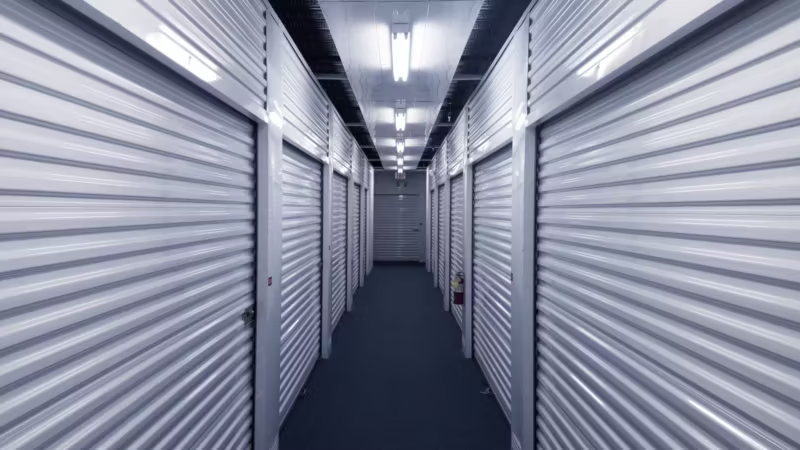 Storage
30 days included, in a facility we control
Storage
30 days included, in a facility we control
-
 Auto transport
open or enclosed, door to door or terminal
Auto transport
open or enclosed, door to door or terminal
-
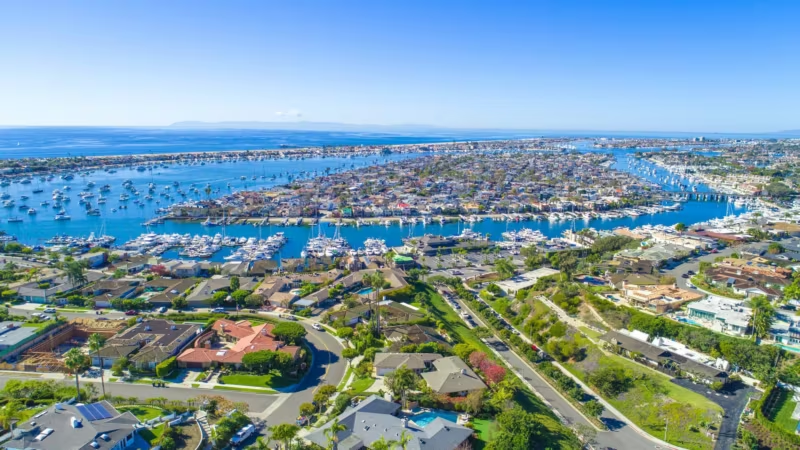 Movers across California
a lane we run from Washington
Movers across California
a lane we run from Washington
-
 Movers across Arizona
a lane we run from Washington
Movers across Arizona
a lane we run from Washington
Reviews from customers on our long-distance lanes
“Their wrapping skills were on point, no dents, scratches or damages found as we unloaded and unpacked.”
-
Ryker H.
Read on GoogleMy residence was a quaint cottage in Modesto, nestled on a hillside with a driveway resembling a winding road. A skilled team of technicians managed to skillfully navigate two compact moving trucks up this challenging driveway. Read the full review Read less
My residence was a quaint cottage in Modesto, nestled on a hillside with a driveway resembling a winding road. A skilled team of technicians managed to skillfully navigate two compact moving trucks up this challenging driveway. They then promptly got to work, packing 85 boxes of books and various other household items with impressive speed. Within the first seven hours, they had packed and loaded one of the trucks, thoughtfully leaving me an area to sleep, eat, and handle my emails. The following morning, they were punctual, arriving shortly after seven. By just after nine, my house was emptied, cleaned, and all my belongings were securely loaded onto the trucks. The new location was close to the old one, and the team swiftly unloaded, unwrapped, and arranged everything in my new home. (They left the unpacking of the books to me.) The team from Cross Country Movers Group then departed just before noon. Their service was remarkably quick, smooth, meticulous, and efficient. The cherry on top was that the final cost came in under the initial estimate, making for a satisfying conclusion to the moving process.
-
Rachel E.
Read on YelpTim was the person who organized my move. He was extremely helpful and responsive. They coordinated movers on the pickup and delivery end who were professional and quick. Read the full review Read less
Tim was the person who organized my move. He was extremely helpful and responsive. They coordinated movers on the pickup and delivery end who were professional and quick. I have to leave off one star because there was a LOT of drama in delivery — after waiting nearly 3 weeks for delivery I was told my stuff would be delivered after the "guaranteed" deadline. Three hours arguing over the phone got them to make the delivery happen in the agreed upon time. Other than being without my things for 3 weeks — almost longer — it was an overall positive experience! All my items are accounted for and looking good. Thanks to everyone, especially Tim, for your help!
-
Allen M.
Read on GoogleIn a pinch, i needed a moving service and a friend pointed me towards a technician from a certain moving company. After reaching out to the technician, he reassured me that they could handle the job of moving my tenants out over two consecutive weekends. Read the full review Read less
In a pinch, i needed a moving service and a friend pointed me towards a technician from a certain moving company. After reaching out to the technician, he reassured me that they could handle the job of moving my tenants out over two consecutive weekends. He was agreeable and flexible to my needs. On the day of the first move, he was punctual and we reviewed all the items in the apartment that needed relocation. Afterward, he briefed his two team members, who happened to be among the friendliest people i've ever encountered. They were extremely careful and patient. The following week, they returned promptly and completed the rest of the move. i can't recommend the technician and his team enough – they are real pros at what they do and you won't be let down. Their rates are very fair considering the successful outcome. I'll be enlisting their services for a third time soon.
Moving in and out of Washington: the practical part
We run into and out of Washington every month, most often Seattle. We run into Arizona, California, Colorado, New Mexico and Oregon on the same crews. The move itself is the predictable part: a survey fixes the inventory and the weight, the weight and the mileage fix the price, and the price goes on the paperwork before anything is loaded.
Seattle access is the real cost variable
Seattle has the steepest residential streets of any metro we serve outside San Francisco, and it has a street-use permit regime for occupying a lane or a parking strip with a truck. Both are survey questions and both have lead times measured in days rather than hours. The pattern we see most often: a buyer or renter who has never seen the street from a truck driver’s point of view, an address that a 53-foot trailer cannot legally or physically stop at, and a shuttle that would have cost the same either way but is much cheaper to schedule three weeks out than to arrange at 8am.
The Seattle end is the variable, not the road
Seattle to San Francisco is 807 miles, Los Angeles 1,135, Phoenix 1,420, and the two cost columns above sit close together because those hauls are close together. The spread between two Seattle estimates at the same weight is nearly always the origin address, and that is what this page’s access sections are about: surveyed and written down up front, not discovered on the day.
The run south crosses somebody else’s chain law
A winter departure for California leaves Washington’s own passes behind and then crosses Siskiyou Summit in Oregon, which carries a chain requirement of its own from 1 November to 31 March. A November-to-March move south gets a little more width in its written window for a pass two states away. A spring or summer date gets the narrow version free.
What we need from you on the first call
Two ZIP codes, a date you are working towards, and roughly how many rooms. That is enough for a coordinator to tell you which lane you are on, what the realistic spread is, and whether anything about either address is going to need a shuttle or a permit. Everything after that is the survey.
How long does a move to or from Washington take?
Seattle to Phoenix is 1,420 mi and runs 4–8 days once loaded; Seattle to Los Angeles is 1,135 mi and 3–7 days, the same numbers as the route table on this page. A lane is as long one way as the other, so those windows hold in both directions. You get the spread in writing on the bill of lading rather than a single date we might miss.
Is it true there is no state income tax in Washington?
Yes, on wage income, and it is one of the few relocation claims you can verify yourself before you decide. We mention it because it is the reason a lot of our Seattle moves happen, not because it changes what a move costs. The moving-day questions in Washington are the street grade, the permit and whether a full-size trailer can reach your door.
Do you serve the whole of Washington?
We deliver anywhere in Washington. Seattle is the metro we crew regularly: the places we know the access before we arrive. Everywhere else starts with the destination ZIP: a coordinator confirms shuttle, permit and access questions before the price is set.
What does a move out of Washington cost?
Weight and mileage set the base, then access. On the market data above, a studio or one-bed to California runs $1,500 – $6,080, and a four-plus-bedroom house to Arizona runs $6,290 – $11,680. Those are third-party rates to sanity-check any estimate against, including ours. A binding price needs a survey, and anybody quoting a firm number off a phone call is guessing.
Can you store my shipment until my place is ready?
Thirty days of storage in transit is included on long distance moves, in a facility we control, going out on a date you set.
Are you a carrier or a broker?
A carrier. We hold our own operating authority, USDOT 2138595 and MC-744411, and our own crews and trucks run the move end to end. You can check both in the FMCSA SAFER database without asking us.
Moving to or from Washington?
Two ZIP codes and a date. A coordinator will call you back with the lane, the spread and what the survey needs to look at.
Get a price for your move from Washington
Two ZIP codes and a date is enough to start. A coordinator confirms the lane, the access at both ends and what the survey needs to look at before anything is booked.