
Interstate household moves
Long distance moving services
Priced by weight and mileage on a binding estimate, loaded and delivered by the same crew, with a written delivery spread on the bill of lading rather than a promise on the phone.
- Our own crews never subcontracted
- Written spread on the bill of lading
- Binding price after the survey
- USDOT 2138595 · MC-744411 checkable on FMCSA SAFER

How a long distance moving price is built
An interstate household move is priced on two things before anything else: how much your shipment weighs and how far it goes. Everything else is added to that base: packing, stairs, a long carry, a shuttle because the trailer cannot reach the door. Weight you can estimate before anybody visits, and that is where the cost table below starts.
Three kinds of estimate, and they are not interchangeable
A binding estimate is a fixed price for the services and quantities written on it. A non-binding estimate is a forecast; the final bill is based on actual weight and actual services. A not-to-exceed estimate is a ceiling: you pay actual charges or the cap, whichever is lower. They are routinely discussed as though they were the same document with different names, and they are not.
What a mover can collect at your door
On a non-binding estimate, federal rules set the limits. If the bill comes to 110 per cent of the estimate or less, the mover may require payment in full at delivery. If it comes to more, the mover must hand over your shipment on payment of 110 per cent of the estimate and defer billing the remainder for at least thirty days. Impracticable operations are the access problems nobody could see from the estimate; charges for them may be demanded at delivery only up to fifteen per cent of all the other charges due. That cap is what stops a crew arriving, announcing the access is bad, and raising the price on the spot.
We quote binding wherever a survey makes it possible, because the argument above is one you should not have to have.
- Binding estimate
- Fixed for the services and quantities shown
- Non-binding
- 110% cap collectable at delivery; the rest deferred 30 days
- Impracticable operations
- Max 15% of all other charges due at delivery
- Delivery
- Written spread on the bill of lading, not a verbal date
The 110 per cent rule, the thirty-day deferral and the fifteen per cent cap on impracticable operations are federal rules that apply to every interstate mover, not terms of ours.
Three things worth checking on any quote
What separates a price from a number
All three are checkable before you book, and two of them are checkable on a federal register rather than on our word.

$75k a broker’s bond, not cargo cover
A broker never takes possession of your things
The FMCSA describes a property broker as an operator that arranges transport using an authorized carrier, "does not assume responsibility for the property and never takes possession of it". A broker holds a surety bond or trust fund of $75,000; that is a financial-responsibility instrument, not cover on your shipment. If the crew at your door works for somebody the broker found, the company you signed with was never going to be the company carrying your furniture. We move on our own authority and our own equipment.

Both public liability and cargo
Household goods carriers have to file cargo insurance
To hold interstate operating authority, a household goods carrier must file proof of public liability and proof of cargo insurance with the FMCSA. A carrier of general property files only public liability; cargo insurance is not required of it at all. So the license class itself tells you something about what stands behind your shipment, and both filings are visible on the FMCSA register under our numbers: USDOT 2138595, MC-744411.

Spread in writing, before loading
The delivery date belongs on the paperwork
On a long haul, a single delivery day is a guess dressed as a commitment: weather, weigh stations and hours-of-service rules all move it. What can be committed to is a spread, and the place for it is the bill of lading rather than a phone call. Ours goes in writing before the truck loads, which also means a delivery outside it is a documented failure rather than a disagreement about what somebody remembers being told.
The broker description and the filing requirements are the FMCSA's own; both are checkable in SAFER before you call anybody.
What it costs
Weight is where the price starts
These are the industry weight bands a survey is measured against, with the transit ranges that go with a coast-to-coast and a regional haul. A survey replaces the estimate with your actual inventory.
| Home size | Typical weight | Coast to coast | Regional haul |
|---|---|---|---|
| Studio or 1 bed usually shares a trailer | 2,000 – 3,500 lb | 7–14 days | 3–7 days |
| 2 bedrooms the most common interstate move | 4,000 – 6,000 lb | 7–14 days | 3–7 days |
| 3 bedrooms usually a large trailer share | 7,000 – 9,000 lb | 7–14 days | 3–7 days |
| 4+ bedrooms often a dedicated trailer | 10,000 – 14,000 lb | 7–14 days | 3–7 days |
Weight bands are the industry rule of thumb, not a quote. Dollar figures are deliberately absent until the rate table is built rather than guessed. A made-up range on a page like this is worse than no range at all.
Get a binding priceHow a long distance move runs
Four stages, and the one that decides the price is the first.
-
Survey, and both ends
Video or in person. Fixes the inventory, the weight and the access at both ends, which is what turns an estimate into a binding number.
-
Estimate and valuation
Estimate, valuation choice and the delivery spread, all in writing. Articles over $100 a pound are declared here by name.
-
Load day at your door
Wrapped, labeled and inventoried at your door by the crew that will unload it. The inventory sheet is what any later claim is measured against.
-
Delivery inside the spread
Inside the written spread, unloaded and reassembled, packing debris removed. Anything damaged is noted on the delivery paperwork while the crew is still there.
What is included as standard
What comes with the move rather than on top of it
These three are standard on a long distance booking, not extras quoted on top of it.
- 30 days
- storage in transit, included on a long distance move
- Full value
- protection applies unless you choose released value
- One crew
- loads and delivers, no partner transfer mid-route
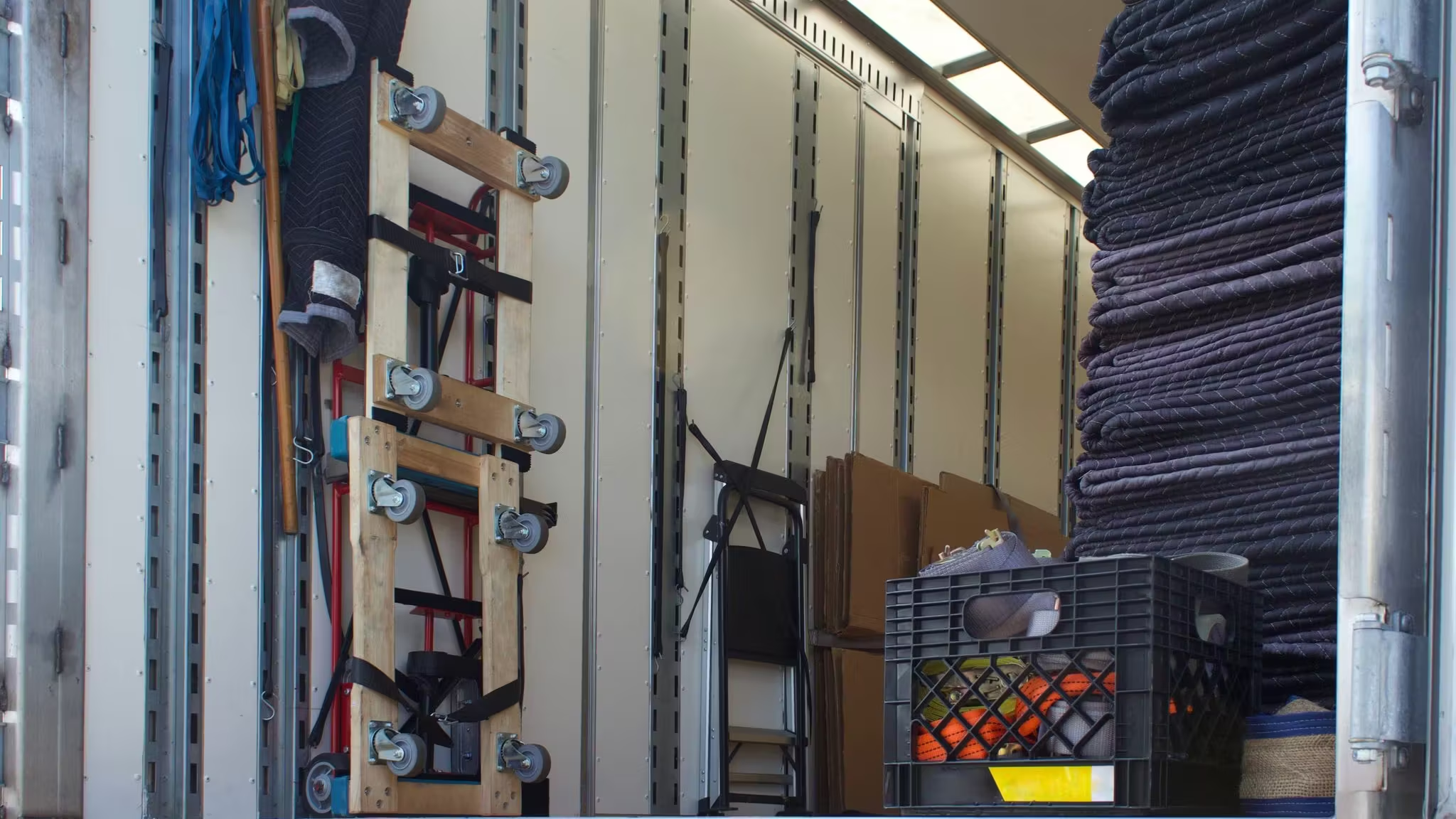
Blanket-wrapped and inventoried before it leaves the door.
What the cover actually paysWhat customers said about the long distance move itself
“Researching online about long-distance moves resulted in many very negative and costly experiences, so we were naturally concerned about selecting a moving company. None of those concerns applied to our experience with CCM and we highly recommend their services.”
-
Joanna M.
Read on GoogleWe reached out to Cross Country Movers Group to assist us when we were preparing to relocate from our 3-story residence of almost 42 years to a new condominium in Modesto. They supplied exceptional service and assistance at each stage. Read the full review Read less
We reached out to Cross Country Movers Group to assist us when we were preparing to relocate from our 3-story residence of almost 42 years to a new condominium in Modesto. They supplied exceptional service and assistance at each stage. As we commenced emptying the house, they efficiently removed a pool table from the basement and an upright piano from the living room, along with the standard large furniture pieces for donation or disposal. Further along, they cleared our attic, basement, and garage of items we no longer required and later transported specified items to our offsite storage unit. On a separate occasion, a team arrived to dismantle and haul away old carpeting. We also utilized their packing service for our delicate items. The owner responds promptly to inquiries and his pricing is reasonable. All of the technicians working for the company are genuine professionals: punctual, amicable, meticulous, and composed. This crew ensures EVERYTHING is clean before they depart! What struck me the most was their understanding of how stressful this situation was and the reassurance they provided that this task could indeed be accomplished. Having such a delightful and concentrated team working to help us meet our objective was a significant stress reducer. We appreciate the efforts of all the workers for their assistance in this monumental move! We anticipate collaborating with them in the future and wholeheartedly endorse them to anyone in need of moving services.
-
Kris T.
Read on YelpI had a great experience with a move from Baltimore to NYC. I only had a few items, and contacted them kind of close to my moving time. Despite my being a last minute relatively small customer, they were super responsive and everything was organized seamlessly. Read the full review Read less
I had a great experience with a move from Baltimore to NYC. I only had a few items, and contacted them kind of close to my moving time. Despite my being a last minute relatively small customer, they were super responsive and everything was organized seamlessly. Everything even arrived exactly when they said it would. Will definitely bookmark them for any future moves.
-
Ryker H.
Read on GoogleMy residence was a quaint cottage in Modesto, nestled on a hillside with a driveway resembling a winding road. A skilled team of technicians managed to skillfully navigate two compact moving trucks up this challenging driveway. Read the full review Read less
My residence was a quaint cottage in Modesto, nestled on a hillside with a driveway resembling a winding road. A skilled team of technicians managed to skillfully navigate two compact moving trucks up this challenging driveway. They then promptly got to work, packing 85 boxes of books and various other household items with impressive speed. Within the first seven hours, they had packed and loaded one of the trucks, thoughtfully leaving me an area to sleep, eat, and handle my emails. The following morning, they were punctual, arriving shortly after seven. By just after nine, my house was emptied, cleaned, and all my belongings were securely loaded onto the trucks. The new location was close to the old one, and the team swiftly unloaded, unwrapped, and arranged everything in my new home. (They left the unpacking of the books to me.) The team from Cross Country Movers Group then departed just before noon. Their service was remarkably quick, smooth, meticulous, and efficient. The cherry on top was that the final cost came in under the initial estimate, making for a satisfying conclusion to the moving process.
Get a binding number, not a range
A survey and one call. No deposit to get a price.
The other four
All servicesEverything is priced separately, so you can take one of these or all of them.
-
Auto transport
Open or enclosed, door to door or terminal to terminal, on the same order as the household goods.
-
Packing and crating
Partial or full, materials included, with custom crates for what will not survive a carton.
-
Storage
Thirty days included on a long distance move, in a facility we control, released on a date you set.
-
Moving insurance
What released value and full value protection actually pay, and the one thing neither covers.
What a long haul looks like at both ends
The same crew at the origin and the destination. On a partner transfer your shipment changes hands somewhere you will never see, and so does responsibility for it.





Where to go next
Every one of these has a page with the local detail: the curb rules, the building practice and the regulator, which differ more between cities than anything about the haul itself.
-
 Los Angeles to New York
2,790 miles, 7–12 days once loaded
Los Angeles to New York
2,790 miles, 7–12 days once loaded
-
 San Francisco to Chicago
2,127 miles, 6–10 days once loaded
San Francisco to Chicago
2,127 miles, 6–10 days once loaded
-
 All moving routes
every lane, with miles and windows
All moving routes
every lane, with miles and windows
-
 Movers in Los Angeles
permits and long carries
Movers in Los Angeles
permits and long carries
-
 Movers in New York
walk-ups and building COIs
Movers in New York
walk-ups and building COIs
-
 Areas we serve
every state we run into
Areas we serve
every state we run into
What is the difference between a binding and a non-binding estimate?
A binding estimate is a fixed price for the services and quantities written on it. A non-binding estimate is a forecast, and the final bill is based on actual weight and services. A third instrument, not-to-exceed, sets a ceiling: you pay actual charges or the cap, whichever is lower.
How much can a mover collect at delivery on a non-binding estimate?
If the bill is 110 per cent of the estimate or less, payment in full may be required at delivery. Above that, the mover must release the shipment on payment of 110 per cent and defer billing the remainder for at least thirty days. It is a federal rule, not a courtesy.
What are impracticable operations?
Access problems that could not be seen when the estimate was written: a shuttle because the trailer cannot reach the door, an excessive carry, stairs nobody mentioned. They can be charged, but only up to fifteen per cent of all the other charges due at delivery.
Is my delivery date guaranteed?
A spread is, and it goes on the bill of lading in writing before we load. A single guaranteed day on a coast-to-coast haul ignores weather, weigh stations and hours-of-service limits, so anybody offering one is either charging for the risk or hoping.
Do you use brokers or partner carriers?
No. We move on our own USDOT and MC authority with our own crews. The FMCSA's own description of a broker is an operator that arranges transport and "never takes possession" of the property, which is the thing to check before you sign with one.
How is weight established?
On a certified scale, not from a bedroom count. The weight tickets are part of your paperwork, and on a non-binding estimate they are what the final bill is calculated from.
Is storage included?
Thirty days of storage in transit is included on a long distance move. Beyond that it moves to a monthly rate quoted before the storage starts.
One survey, one binding price
Two ZIP codes and a date to start. A coordinator calls you back.
Get a price for your long distance move
Two ZIP codes and a date is enough to start. A coordinator confirms the inventory, the access at both ends and the delivery spread before anything is booked.