
San Francisco, CA
Long distance movers in San Francisco
The distance is the easy part here. We pull the SFMTA no-parking permit at least five working days out, and we tell you at survey whether your street needs a shuttle instead of a trailer.
- Permit pulled SFMTA, five days out
- Shuttle priced before the day, not on it
- COI issued direct to building management
- USDOT 2138595 · MC-744411 checkable on FMCSA SAFER
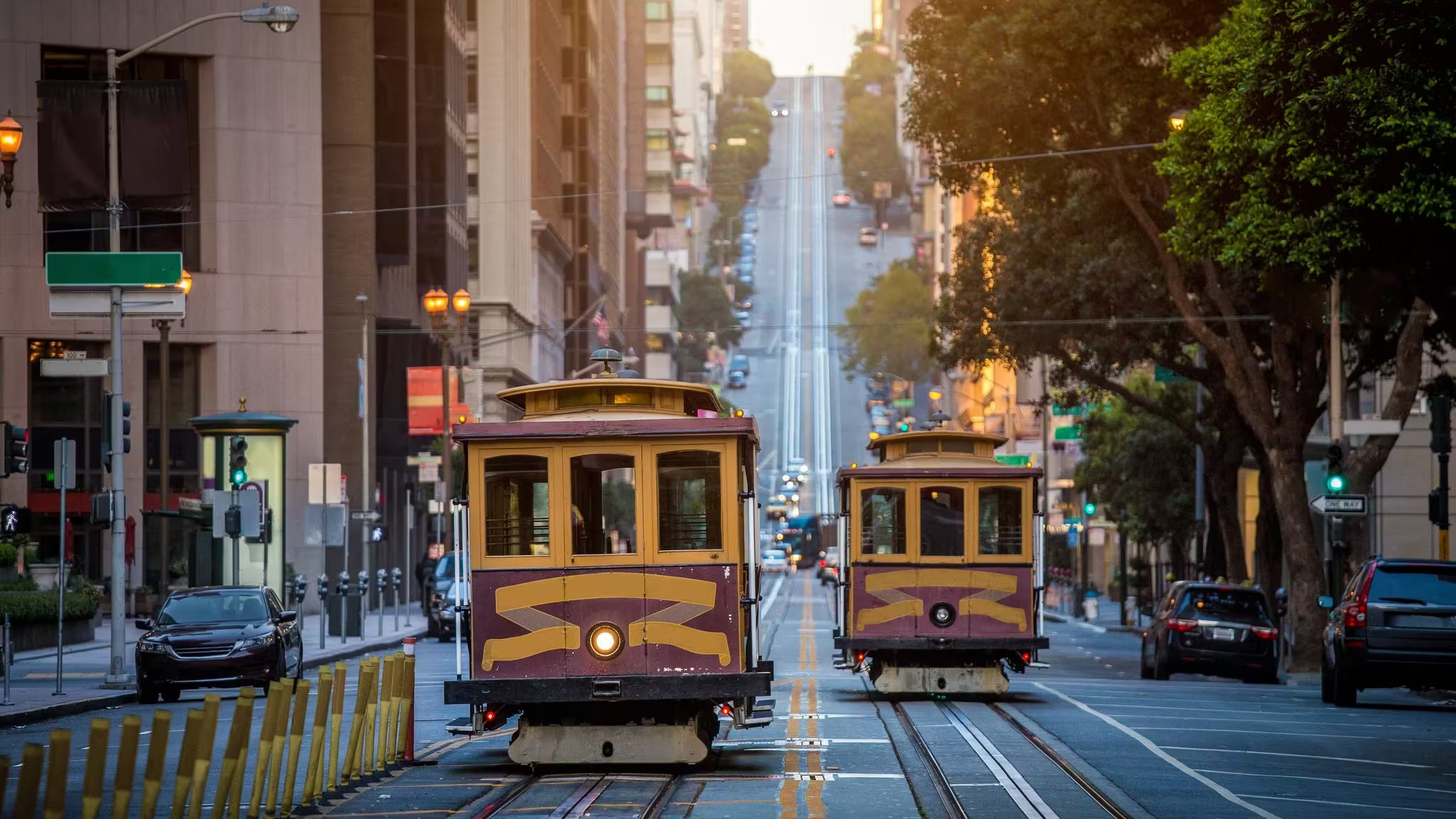
San Francisco, CA
What a long distance move from San Francisco involves
San Francisco needs an SFMTA temporary no-parking permit.
We file it, plan the last fifty feet, and quote one binding price before you pack. It sits inside the price you were quoted rather than arriving afterwards.
The rest is the ordinary work: a survey that counts what you own, a binding price in writing, our own crew loading and delivering, and thirty days of storage if your dates slip.
Moving services in San Francisco
-
Long distance moving Out of San Francisco on our own trucks.
-
Auto transport Open or enclosed, with $100,000 or $500,000 of cover.
-
Packing and crating Partial up to fifteen boxes, full beyond, crates for the rest.
-
Storage Thirty days included on a long move.
-
Moving insurance What each level of cover actually pays.
Why people book us for a move from San Francisco
- 1,789
- Households moved
- 160
- Crew
- 28
- Cities
-
 Your quote is your final price, in writing after the survey
-
 Trained crews on our own payroll, never day labor
-
 Licensed and insured under our own USDOT and MC authority
-
 Thirty days of storage included on long distance moves
-
 We file and pay the San Francisco street permit as part of the booking
What it costs
What moving from San Francisco typically costs
Price comes from weight and mileage first, then access — and in San Francisco access is the part that moves the number.
| Home size | Typical weight | To New York | To Seattle |
|---|---|---|---|
| Studio or 1 bed one bedroom of contents | 2,000 – 3,500 lb | $1,600 – $7,061 | $1,396 – $4,858 |
| 2 – 3 bedrooms the most common interstate move | 4,000 – 9,000 lb | $4,497 – $8,933 | $2,506 – $6,369 |
| 4+ bedrooms often needs a trailer to itself | 10,000 – 14,000 lb | $8,461 – $15,154 | $4,715 – $8,951 |
The dollar ranges are the MARKET rate for these lanes, not our quote: San Francisco to New York and San Francisco to Seattle. moveBuddha's monthly dataset of live quotes across vetted movers, last updated 31 August 2026. Weights are the industry rule of thumb. We price your move from a survey of your actual inventory and give you one binding number in writing, which is why no figure above is presented as ours.
Get a binding priceIncluded and extra
What your final price includes
The complaint in this industry is always the bill that grew. This is the line between included and extra, before you have to ask.
- Included One truck, one crew The crew that loads you is the crew that unloads you.
- Included Storage for 30 days Useful when a closing slips.
- Included Basic cover 60 cents for every pound an item weighs.
- Extra Full cover Pays to repair or replace what we list together.
- Extra Packing and crates Up to 15 boxes is partial, more than that is full.
- Extra Car shipping Open or enclosed.
- Extra The street permit Its own line on your estimate, not hidden in a total.
How your move from San Francisco works, step by step
Five points, and the first three all happen before a truck is booked.
-
Survey, and the street
We count the inventory and look at the address: the grade, the width, whether a trailer can turn in, and how many stairs with turns in them are between the door and the curb.
-
SFMTA permit and signs
We apply to SFMTA at least five business days out — longer in summer — and post the signs. A move between two city addresses needs a permit at each end.
-
A written estimate
Weight, mileage, the permit and the shuttle if one is needed, in writing before anything is booked. The shuttle is the line people are surprised by, so it goes in early.
-
Load day
The trailer sits where it can legally sit and the shuttle works your door. On a walk-up the crew is sized for the stairs rather than for the square footage.
-
Transit and delivery
Eastbound crosses Donner Pass. In winter that means chain controls, a 30 mph limit through the restriction and occasionally a closed pass, which is why the delivery is a window and not an hour.
Long distance moving routes from San Francisco
Road distance and the transit window we plan against on the lanes we run most from the city.
-
 San Francisco, CA → Chicago, IL
-
 San Francisco → New York
-
 San Francisco → Dallas
-
 San Francisco → Denver
-
 San Francisco → Seattle
-
 San Francisco → Los Angeles
- Permit
- $355 SFMTA, 1–4 signs, up to 3 days
- Permit notice
- 5 business days minimum, more May to September
- Homes pre-1940
- 44% walk-ups and narrow stairs
- To the east coast
- 7–12 days San Francisco to New York, 2,902 mi
Sources: SFMTA published temporary signage fee table, effective 1 July 2026 — metered locations add $21 per meter per day; US Census via Axios San Francisco. Fees re-checked 28 August 2026.
San Francisco's SFMTA no-parking permit, and the last fifty feet
A San Francisco move is not decided by the two thousand nine hundred miles. It is decided by the last fifty feet.
Start with the curb. The city requires an SFMTA temporary no-parking permit to hold space for a truck, and it is not a formality. The published fee is $355 for one to four signs on a permit of up to three days, four to seven days adds $64, and a metered block adds $21 per meter per day on top. That last one is worth reading twice, because the zone is billed in five-day increments on metered spaces — so a one-day move against two meters is charged as ten meter-days, not two. The application needs a minimum of five business days between filing and enforcement, longer between May and September when everybody moves, and a move from one San Francisco address to another needs two permits. We pull them as part of the booking, which is the difference between a reserved curb and a crew circling Nob Hill with a loaded trailer.
Then there is the posting rule, which is the part that catches people who have organized a move somewhere else. The signs have to go up at least 72 hours before enforcement starts at an unmetered location, and 24 hours at a metered one. Three days, not the morning of. It is the same split Washington DC uses, which is convenient if you have moved between the two, and completely counterintuitive if you have not: the expensive curb needs more notice, not less.
Then the hill. Bradford Street runs at 41%, Romolo at 37.5%, and Filbert and 22nd — the two everybody photographs — at 31.5%; 22nd drops seventy-nine feet in a single 250-foot block. A 53-foot trailer does not work a street like that and frequently cannot turn into it. The answer is a shuttle: a 26-foot truck works your door and transfers to the trailer parked somewhere it can legally sit. That is a real line on the estimate and we price it at survey rather than discovering it on the morning.
Then the building. Forty-four per cent of San Francisco homes were built before 1940 and the median one went up in 1948 — the third oldest housing stock of the hundred largest counties in the country. That means staircases with turns in them, doorways narrower than a modern sofa, and no service lift. Hoisting, taking a door off its hinges and partial disassembly are ordinary here, not exceptional.
One thing that is genuinely about the distance: every eastbound lane out of San Francisco crosses Donner Pass on I-80. In winter that means chain controls, a 30 mph limit, trucks held at Applegate while the pass is restricted, and several full closures a season. It is why an eastbound delivery in January is a window rather than a date.
What decides a San Francisco move
Three things happen in the last fifty feet
The curb, the hill and the staircase. Each one is priced at survey here, because each one is a cost rather than an inconvenience.

$355 SFMTA permit, 1–4 signs, up to 3 days
What the SFMTA curb permit costs
The published SFMTA fee is $355 for one to four signs, plus $21 per meter per day on a metered block — billed in five-day increments, so a one-day move against two meters is charged as ten meter-days. Five business days minimum between filing and enforcement, longer through the summer, and signs posted 72 hours ahead at an unmetered curb or 24 at a metered one. A move within the city needs two permits. We pull them with the booking.

41% grade on Bradford Street
Working a hill a trailer cannot climb
Filbert and 22nd run at 31.5% and 22nd drops seventy-nine feet in one block. A 53-foot trailer cannot work those streets, so a 26-foot shuttle takes the address and transfers to the trailer. Priced at survey, not improvised on the day.

44% of homes built before 1940
Turning staircases in pre-war homes
The median San Francisco home went up in 1948, the third oldest stock of the hundred largest US counties. Turning staircases, doorways narrower than a modern sofa, and no service lift. Hoisting and door removal are routine rather than exceptional.
Sources: SFMTA published temporary signage fee table, effective 1 July 2026, re-checked 28 August 2026; city grade survey (datapointed / 7×7); US Census via Axios San Francisco.
Protection
Moving insurance: what your belongings are covered for
Every interstate move carries released-value liability by law, and it is lower than almost everyone expects: sixty cents per pound of the item, not what the item is worth. On a staircase move that distinction matters more than usual — the things most likely to catch a banister are rarely the heaviest.

- 60¢ / lb
- released value — free, but you have to choose it
- Full value
- the federal default if you choose nothing
- $100k / $500k
- auto transport, open or enclosed
Crating and door removal are ordinary on pre-war stock, not extras.
What each level actually paysWant the permit and the shuttle priced before you book?
Two ZIP codes and a move size is enough to start.
Where we load in San Francisco
Three kinds of address, three kinds of load.





-
Downtown and Mission Bay
Financial District · SoMa · Mission Bay
A booked dock, a service lift and a certificate to management. Settled at survey rather than on the morning of the move.
-
Hills and pre-war stairs
Nob Hill · Russian Hill · Telegraph Hill · Noe Valley
Grades a trailer cannot work and staircases narrower than a modern sofa. A 26-foot shuttle takes the address and transfers.
-
Peninsula and East Bay
Daly City · South San Francisco · Oakland · Berkeley
Outside SFMTA, so the $355 permit and the five-business-day filing do not apply. Different city, different curb rule.
Reviews from customers on our long-distance lanes
“My husband and I recently made a cross country move from SF Bay area to Maryland. We used Cross Country movers and had an excellent experience.”
-
Gilbert D.
Seattle, WA → Southern California
Read on YelpCross Country Movers made our lives so much easier during our move from Seattle WA to So Cal. They handled our home goods with care. The guys were friendly and worked at a good pace! Read the full review Read less
Cross Country Movers made our lives so much easier during our move from Seattle WA to So Cal. They handled our home goods with care. The guys were friendly and worked at a good pace! They were on time with pick up and delivery considering I was under a time constraint to leave Washington and settle in in Cali. I was pleased to see my furniture still intact after the long haul. Their wrapping skills were on point, no dents, scratches or damages found as we unloaded and unpacked. The guys seemed knowledgeable and were self-sufficient. They did most of the leg work which I appreciated. Super thankful for them considering the short notice. Recommended from a friend and I'm definitely recommending it for anyone who needs to move across state lines. Hopefully you have
-
S. Chase
Read on GoogleYears ago, my spouse and I had to relocate, marking our first experience with moving. When the time came for us to move again, this time to be closer to our children, we were unsure about the process. Fortunately, we had the privilege of working with Cross Country Movers Group. Read the full review Read less
Years ago, my spouse and I had to relocate, marking our first experience with moving. When the time came for us to move again, this time to be closer to our children, we were unsure about the process. Fortunately, we had the privilege of working with Cross Country Movers Group. This professional team turned our moving experience into a stress-free and enjoyable one. We are grateful for the exceptional service provided by the dedicated technicians at Cross Country Movers Group. Their hard work ensured that we were able to stick to our moving schedule. I would strongly recommend this company to anyone in need of moving services, regardless of the distance. Cross Country Movers Group offers reasonable prices and their service is outstanding. Above all, they prioritize providing a worry-free experience for their clients. Their technicians are among the best in the moving industry. If you're fortunate enough to work with them, you'll know exactly what I mean.
-
Joni T.
Read on YelpMoving sucks, moving across country to a brand new State sucks, finding someone who actually knows to move things properly is super stressful too. How was I about to go about this to move from state to state without having to drive cross country? Read the full review Read less
Moving sucks, moving across country to a brand new State sucks, finding someone who actually knows to move things properly is super stressful too. How was I about to go about this to move from state to state without having to drive cross country? My friend suggested to go with movers on Yelp and I stumbled upon Cross Country Moves in DTLA. Rent in DTLA is ridiculous so I need to move for the better. I called for a quote, they replied back within 10 mins, maybe even faster as I shopped around for other places. Got my quote, of course it is within reason, would be less of a hassle then renting a giant uhaul and driving there myself and finding someone in Texas to unload my heavy furniture and belongings. They arrived ON TIME at my place and handled all my things with care. They wrapped up my fragile glass cabinets and tapped it up which was a sigh of relief for me, I paid a lot for that cabinet. Anyway, everything was packed neatly and didn't take as long if I were to do with my friends and I because we wouldn't know how as they are professionals. They even had special crates for my fragiles and valuables! Overall it was a great experience and helped me out a ton! They arrived at my new place on time again! That's twice now! Timing is everything because timing is scarce for me as I have to get on with my new life in Texas! I recommend anyone to saving yourself the trouble and asking Cross Country Movers what they can do for you!
Where to go next
-
 Movers across California
state guide
Movers across California
state guide
-
 Movers in Los Angeles
the other end of the state
Movers in Los Angeles
the other end of the state
-
 Long distance moving
how the price is built
Long distance moving
how the price is built
-
 Areas we serve
the states we run into
Areas we serve
the states we run into
Do I need a parking permit, and who pulls it?
Yes, and we do. San Francisco requires an SFMTA temporary no-parking permit to hold curb space for the truck. The published fee is $355 for one to four signs on a permit of up to three days, and a metered block adds $21 per meter per day, billed in five-day increments. SFMTA needs a minimum of five business days between filing and enforcement — longer between May and September — and the signs go up 72 hours ahead at an unmetered curb, 24 at a metered one. If you are moving from one city address to another you need one at each end.
Can a full-size trailer reach my address?
Often not. Bradford Street runs at 41%, Filbert and 22nd at 31.5%, and many streets that are not famously steep are still too narrow or too tight to turn a 53-foot trailer into. We look at the actual address at survey rather than assuming.
What is a shuttle and what does it cost?
A 26-foot truck works your door and transfers the load to the trailer parked where it can legally sit. It is a separate line on the estimate because it is extra labor and a second vehicle, and we price it at survey — it is the item people are most often surprised by when another company leaves it until the day.
My flat is a walk-up with a turn in the stairs.
That is the normal San Francisco job: 44% of the city’s homes were built before 1940 and the median one in 1948. We size the crew for the stairs rather than the square footage, and hoisting or taking a door off its hinges is ordinary work here rather than an exception.
You are an interstate carrier — what about a move inside California?
Different regulator. Interstate moves are federal: USDOT 2138595 and MC-744411, both checkable on the FMCSA register. A move that starts and ends inside California falls under the CPUC instead, which requires a household goods carrier permit — a CAL-T number — from every mover with no exemption for small operators. Ask any company for its CAL-T and verify it with the CPUC before booking an in-state move.
How does winter affect an eastbound delivery?
Every eastbound lane out of San Francisco crosses Donner Pass on I-80. In winter that means chain controls, a 30 mph limit through the restriction, trucks held at Applegate while the pass is closed to them, and several full closures a season. We build that into the delivery spread rather than promising a date we would then miss.
What is my furniture actually insured for?
By default sixty cents per pound of the item — the federal released-value standard, included at no cost. That is weight, not worth. Full-value protection is the paid alternative on an inventory we declare together, and on a staircase move it is worth more than usual, because the things most likely to catch a banister are rarely the heaviest.
Can you store my things between leases?
Thirty days of storage in transit is included, in a facility we control. It is the normal answer when a San Francisco lease ends before the next one starts, and it does not have to be decided at booking.
Moving out of San Francisco?
The permit pulled, the shuttle priced, and a binding number before you book.
Get a price for your move from San Francisco
Two ZIP codes and a date is enough to start. A coordinator confirms the permit and whether the street needs a shuttle before anything is booked.